Applied R&D
Field constraints become engineering briefs.
 Bharat Wire MeshPrivate LimitedTechnical enquiry
 Research & defence innovation · India
Bharat Wire Mesh turns difficult field requirements into research-led, manufacturable protection systems—built around original thinking, rapid iteration and operational purpose.
Field constraints become engineering briefs.
Six company-designated patented technologies plus three engineered protection offerings.
Design, fabrication and iteration under one roof.
Patented & engineered products
Six company-designated patented technologies are joined by three engineered offerings spanning ballistic protection, firing-range infrastructure and intelligent perimeter security.
Patent particulars and controlled validation records accompany applicable technical dossiers. Product claims remain configuration-specific; visuals are identified by evidence type.

The New Innovation emblem identifies this original product dossier while an approved product photograph is prepared.
Company baseline: Standard ready-to-ship models are available in 6 m, 9 m and 12 m lengths, with custom-made options configured to requirement. Optional chemical, biological and nuclear attack-protection configurations are also available. Bharat Wire Mesh describes the platform as a first-of-its-kind offering in India; final protection levels remain subject to project specification and validation.
Create a protected underground operating space quickly, with less site construction after excavation.
A factory-prefabricated steel capsule with heat exchange, tunnel ventilation, HEPA and activated-charcoal filtration, air conditioning and antimicrobial stainless-steel interiors.
A compact, faster-to-install habitat configurable for operations, living, medical, communications and storage roles.
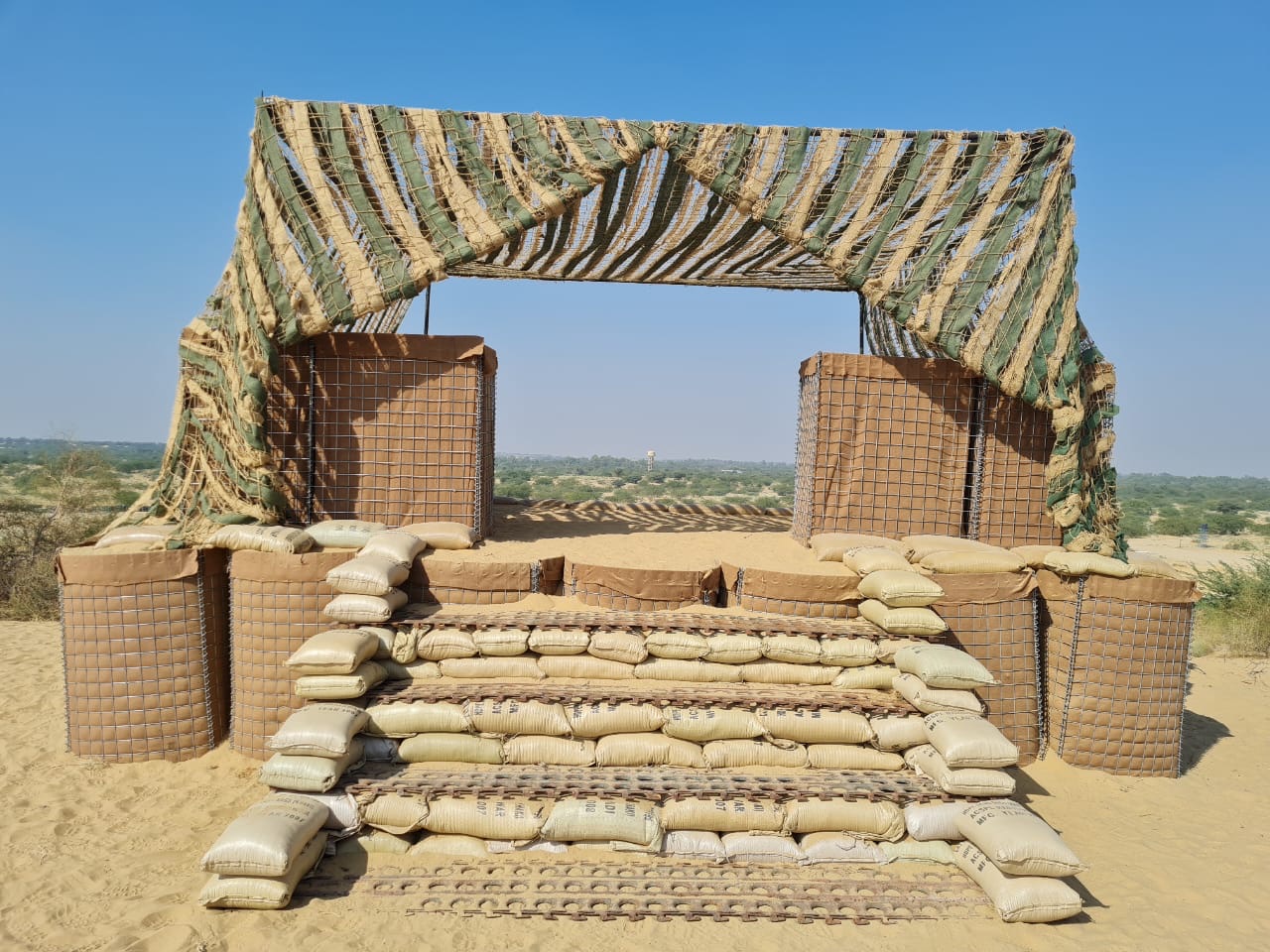
Filled welded-wire cells incorporated into a combined protective position with overhead camouflage screening.
Public BWM specification: 3–5 mm wire with 50 × 50 mm, 75 × 75 mm or project-specific mesh; filled with sand, gravel, rubble, crushed stone or earth.
Build substantial protective or containment barriers while limiting transported bulk and installation time.
Collapsible galvanised welded-wire cells with a UV-stabilised geotextile liner, expanded on site and filled with compatible local material.
Transport-efficient, modular protection for perimeters, temporary works, flood response and erosion-control applications.
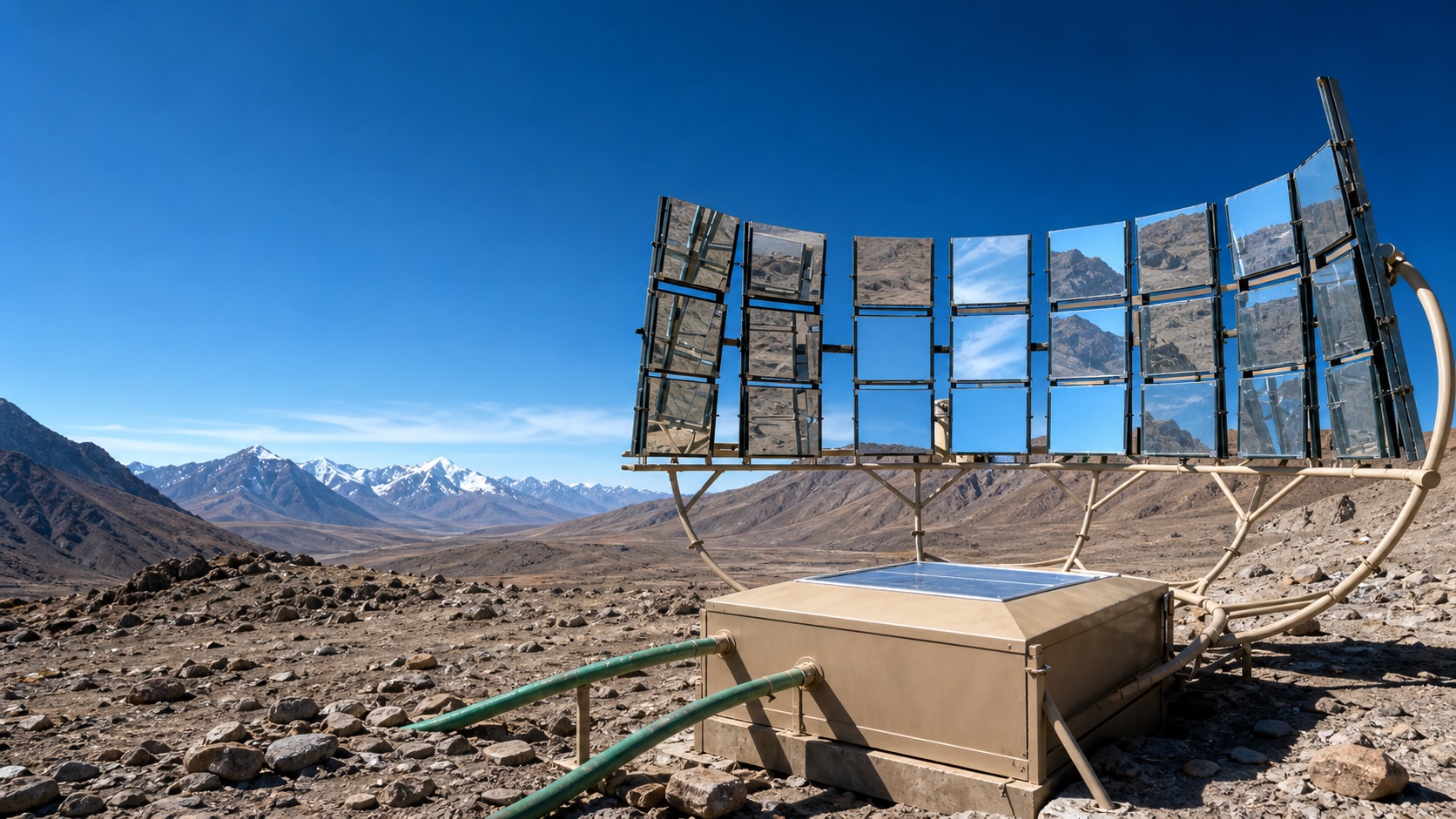
Illustrative high-altitude configuration showing the insulated treatment module and solar-collection assembly.
Company-deck baseline: 8,000 L volume, 60 mm insulated panels, 100 mm inlet and outlet connections and a 27-mirror solar collection assembly.
Maintain dependable sanitation where extreme cold suppresses biological activity and remote access makes servicing difficult.
An insulated, solar-assisted modular treatment tank with auxiliary electrical heating and a separate upper solar assembly.
A purpose-built sanitation platform for high-altitude posts, remote worksites, camps and long-duration field infrastructure.
The New Innovation emblem identifies this original product dossier while an approved product photograph is prepared.
Catalogue baseline: five passive layers, optional side curtains and asset-specific support geometry. Performance and acceptance remain configuration-specific.
Reduce direct small-UAS and payload approach paths to exposed overground assets and critical field infrastructure.
A configurable stand-off envelope combining camouflage, fibreglass anti-drone net, interwoven steel mesh and 3 mm and 4 mm corkscrew-net layers.
Adaptable overhead and perimeter coverage with replaceable layers, while sensors and approved counter-UAS elements remain separately integrated.
The New Innovation emblem identifies this original product dossier while an approved product photograph is prepared.
Concept architecture: 3 mm interwoven, 3 mm and 4 mm corkscrew overhead layers with a 2 mm side curtain. Bridge-specific engineering and trials are required.
Maintain personnel and vehicle movement across exposed modular bridges while protecting the overhead and flank approaches.
A removable protection kit with three overhead net layers, portal-bay supports and a welded-mesh side curtain kept separate from the bridge load path where feasible.
A serviceable protected corridor designed for field installation, isolated layer replacement and recovery without redefining the base bridge system.
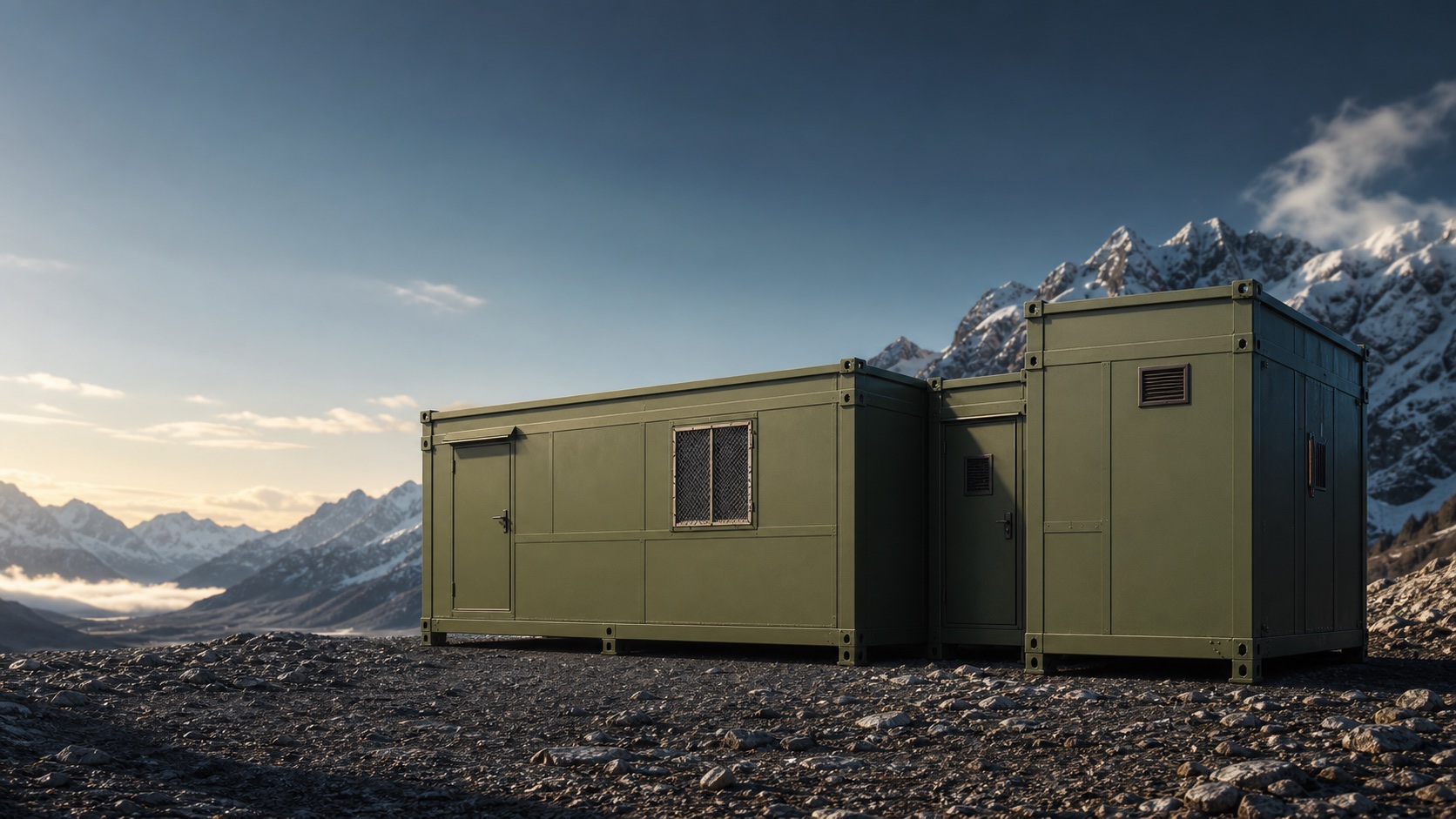
Illustrative cold-region deployment showing a modular insulated shelter family on remote terrain.
Source-deck baseline: compact transport state, supplied gantry, adjustable footing and a stated 30–45 minute erection sequence for the defined configuration.
Establish habitable accommodation and workspace rapidly across cold, uneven and difficult-to-access terrain.
A foldable insulated shell with height-adjustable footing, integrated electricals and optional solar, battery and hot-water floor-heating packages.
A common deployable platform configurable for accommodation, medical, command, workspace, sustenance and storage requirements.
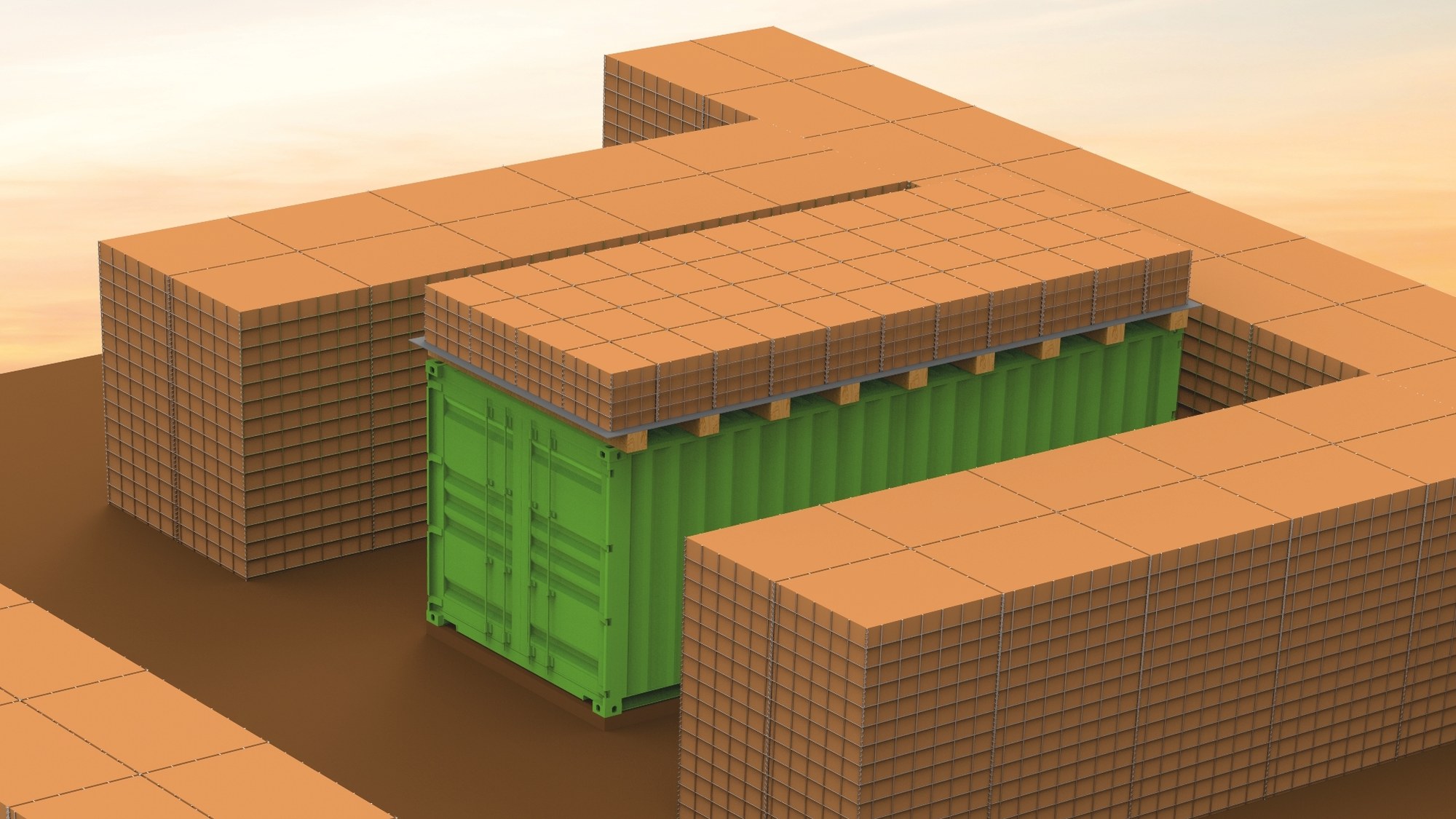
Concept rendering of a configurable Modular Ballistic Protection System arranged around a protected storage container.
Supplied catalogue baseline: steel-wire modules with sand fill, fitted bags or liners, wire pinning and locking elements arranged as perimeter and overhead protection. Dimensions, fill specification, structural design, ballistic threat level, test standard and security integration remain project-specific; protection applies only to the engineered and validated final configuration.
Protect ammunition stores, base camps, mobile camp hospitals and other mission-critical assets in forward, field and high-threat environments.
A mission-configurable barrier system using steel-wire containment modules, sand fill, wire pinning, locking elements and fitted liners. Wall and overhead arrangements can be configured around storage containers and integrated with wider site security.
Modular construction allows the protective envelope to be adapted to storage layouts and deployed across military depots, forward positions, base camps and selected static facilities.
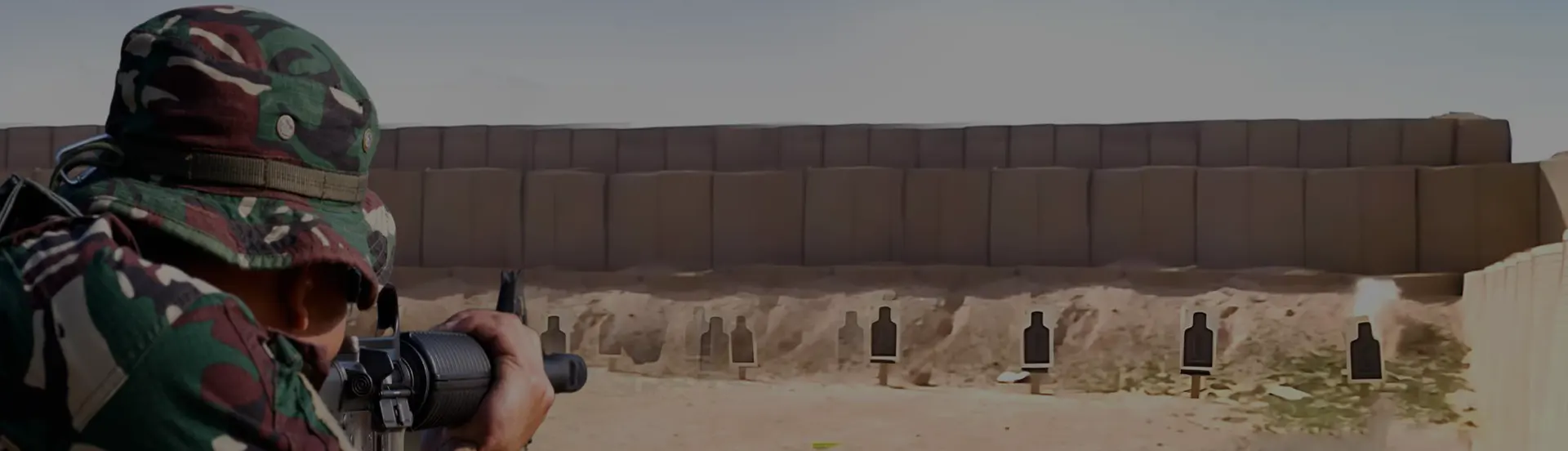
Outdoor live-fire range shown with filled protective barrier structures; final layout and performance are project-specific.
BWM public baseline: consultation, design, fabrication, transport and support for firing-range infrastructure. Range type, weapon and ammunition envelope, danger-area analysis, ballistic containment, ricochet control, targetry, ventilation, acoustics, fire and life safety, approvals and acceptance testing remain project-specific.
Create a controlled live-fire training environment while coordinating containment, access, range geometry and site constraints.
A project-specific range package developed from consultation and design through fabrication, transport and support, with protective works configured to the approved operating brief.
A coordinated delivery scope that aligns range layout, fabricated protection systems and installation interfaces for dependable training operations and maintainability.
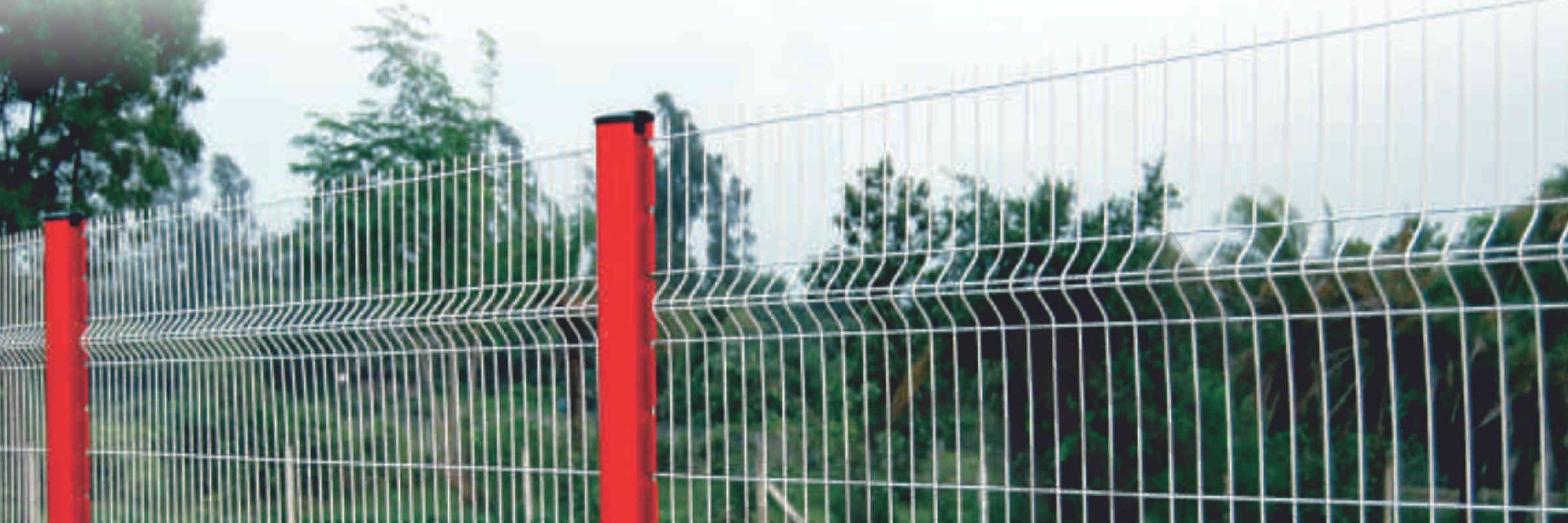
3D welded-panel configuration shown with profiled mesh and steel posts; intrusion-detection integration is engineered to site.
358 baseline: 76.2 × 12.7 mm mesh with 4 mm galvanised wires, resistance-welded at each intersection. The BWM 3D fence brochure describes approximately 50 × 200 mm mesh using 4.0, 4.5 or 5.0 mm wire. Panel dimensions, posts, coatings, toppings, detection zones and alarm performance are engineered and validated for each site.
Critical perimeters need a physical barrier that resists climbing and cutting while identifying fence, wall or ground disturbance early enough for a controlled response.
Close-aperture 358 anti-climb mesh and rigid 3D welded panels are configured on steel uprights, with optional fibre-optic intrusion detection installed on the fence, wall or within the protected-side ground.
A layered perimeter combining physical delay, clear sightlines and centrally monitored detection for defence, critical-infrastructure, industrial and other high-security sites.
The BWM R&D loop
The best protective technology is not the most complicated. It is the one that respects the people deploying it, the terrain around it and the time available.
Terrain, time, transport, manpower and threat conditions define the real brief.
Materials, geometry, joining and deployment logic are resolved as one system.
Concepts become physical assemblies that reveal what drawings cannot.
Each iteration is reviewed against its intended environment and use sequence.
The final idea is translated into repeatable fabrication and project delivery.
Reduce complexity at deployment—not rigour in development.

Scientist · Inventor · Builder
At Bharat Wire Mesh, Mohit Gupta leads the exploration of deployable protective structures, engineered mesh systems and mission-specific fabrication.
His approach begins with the conditions people face. The team isolates the engineering problem, challenges accepted formats and iterates until a solution is practical to transport, clear to assemble and ready for repeatable manufacture.
Rapid-deployment protection
Perimeter & field security
Mission-specific engineering
Beyond a product catalogue
A procurement-friendly view of where Bharat Wire Mesh applies its materials knowledge, fabrication depth and system thinking.
Fast establishment after excavation with controlled internal conditions
Prefabricated steel capsules, filtered ventilation and configurable fit-out
Operations, living, medical, communications and protected storage roles
High-volume protection with a compact transport footprint
Collapsible lined-wire cells using compatible fill available near site
Perimeters, temporary works, flood response and erosion management
Cold-climate treatment where access and maintenance are constrained
Insulated modular tank, solar collection and auxiliary heating
High-altitude posts, camps, remote worksites and disaster response
Direct approach paths to exposed overground assets
Layered stand-off nets, support structures and replaceable elements
Stores, vehicle parks, shelters, maintenance areas and command posts
Overhead and flank exposure at modular bridge crossings
Removable net layers, portal bays and side-curtain mesh
Personnel movement, logistics routes and operational vehicle crossings
Rapidly habitable space on cold, uneven and remote ground
Foldable insulated shell, adjustable footing and integrated services
Accommodation, medical, command, workspace and storage modules
Configurable protection where permanent construction is impractical
Filled welded-wire traverses, screened routes and engineered overhead works
Mission-critical stores, exposed working areas and field infrastructure
Coordinated containment, access, geometry and operating requirements
Consultation, design, fabrication, transport and delivery support
Project-specific indoor and outdoor firing-range environments
Physical delay combined with early detection of perimeter disturbance
358 anti-climb or 3D welded mesh with optional fibre-optic detection
Defence, critical-infrastructure, industrial and high-security sites
A hard problem is a good place to begin.
Share the operating environment, deployment constraint or protective challenge. Our team will help shape the right technical conversation.
For field needs, upgrades and mission-specific protection systems.
For integrated fabrication, project adaptation and scalable supply.
For applied research, prototyping and engineering collaboration.